

By Hema Senanayake –

Hema Senanayake
Still we do not have a clear pronouncement of intended policy programs or work programs which are going to be implemented by the new National-Unity-Government (NUG). Since there are significant differences between the UNFGG’s manifesto and UNFA’s manifesto, people do understand that the NUG cannot implement any one of the political factions manifesto in full. Hence, immediately, the principle challenge before the National-Unity-Government is to redefine or spell out the scope, characteristics and components of the policies and programs of the new government. This is important to avoid any misunderstanding between the forces of UNFGG and the forces of UNFA which support for NUG. For example, UNFGG’s Megalopolis project could be one of such projects that need to be redefined under NUG. Why?
Megalopolis project is the UNFGG’s flagship project mentioned in its manifesto. On the contrary, UNFA has no such program mentioned in its pre-election manifesto. However, now we have a National-Unity- Government (NUG). Among the Ministers of NUG, there could possibly be a one special Minister. He is the Minister for Megalopolis. Sri Lanka never had such a portfolio before or even such a subject under any Ministry. This is a new Ministry. So, what the Minister for Megalopolis is going to do?
He is going to put up a Megalopolis in the Western Province which will have a population of over 8 million. The word Megalopolis is now commonly mispronounced as Megapolis. The word “Megalopolis” is used to define an extensively large city. Anyway, for this article let us use the word Megalopolis to define the project that comes under the purview of the Minister of Megapolis.
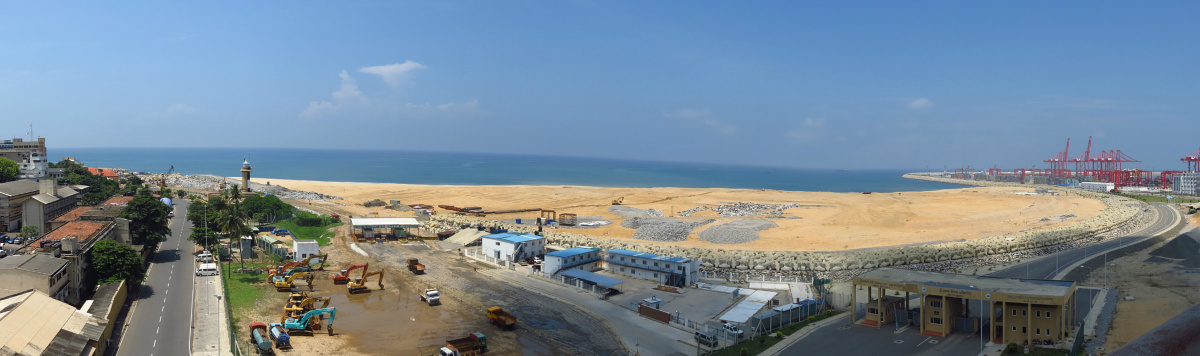
The concept of Megalopolis has been proposed to Sri Lanka by the Manifesto of UNFGG. According to the original proposition of the project, it is not just a project; instead it is going to be the flagship project in developing the Sri Lanka’s economy in the next five years. That is why the Megalopolis project needs to be discussed and be debated in the new parliament in order to ascertain the scope of project, its components and as to how those components are going to be financed. Since, the Sri Lanka’s economic development depends on this project, as it is proposed in the manifesto; this would be seen as an inevitable project in regard to the economic development of the country. Is the project appropriate for Sri Lanka as at now?
Sri Lanka is not a country that runs with a surplus in its “current account.” Sri Lanka is posting a current account deficit for a long time. Also, its current account deficit is not balanced out from the non-credit inflow of foreign currencies such as U.S. dollars. This means the country’s Balance of Payment (BoP) is maintained with continuing borrowed money from foreign sources. Under such circumstances I particularly concern about the financing of Megalopolis project and how it is going to affect the country’s current account and BoP in the medium to long term. Therefore, we will have credible answers to those concerns if the project is debated in the parliament.
I never intend to doubt that a country like Sri Lanka under the existing situation of its current account, BoP and increased consumption levels, cannot have Megalopolises. It can, but it requires a major shift in the mind-set of general populace in regard to the transformation of certain services into sellable services, promotion of certain foreign investments and flexibility in owning of properties by foreigners. If we do not do those things, I doubt very much, Sri Lanka’s capacity to do such a project by its own funds because this project will be huge. Let us have a quick look of this project as proposed by UNFGG.
“More than 50% of global population lives in cities. Eighty percent of global Gross-Domestic-Product is produced by them (this columnist observes that the term “global Gross Domestic Product” must be corrected as global “Gross-World-Product” (GWP)). The economic power concentrated towards cities due to employees, entrepreneurs and higher population densities are concentrated into one area and also due to the emergence of extensively large market. Megalopolises are the lifelines of global economy. Therefore, the success of Sri Lanka’s economy shall depend on its ability to build such a Megalopolis.” (UNFGG Manifesto, page 17 & 18. This is translated into English from Sinhala version of the Manifesto).
Please read the last sentence of the above quote again. It says, “… the success of Sri Lanka’s economy shall depend on its ability to build such a Megalopolis.” This economic vision is different from the economic vision which says that, “the success of Sri Lanka’s economy shall depend on its ability to expand its agro-industrial and industrial base. If any government accepts the latter economic vision then such a government will concentrate more on building the useful infrastructure that facilitates the expansion of agro-industrial and industrial base. Both economic visions are good. But in the process of economic development of any country at any given point, one vision may be appropriate than the other. Let me give you a quick example.
When the United States envisioned for a new industrial revolution, the U.S. spent more money in building up infrastructure to facilitate doing researches. It expanded the country’s ability to produce newer products. The U.S. still expands its useful agro-industrial and industrial base even though the government is supportive for the expansion of large financial markets rooted in Megalopolises like New York etc. Under the Obama administration the U.S. envisioned to be self-sufficient in producing fuel and they will achieve their goal in 2017. The U.S. values its agro-industrial and industrial base and the U.S. always has been continued to focus on having useful infrastructure that supports useful production even though the U.S. imports a lot of products.
When the U.S. hit a massive economic crisis in 2008, the U.S. government did not think of building a few more Megalopolises. By that time the U.S. government observed that the private consumption was so low which resulted in reducing output leading to an economic recession. Hence, the government decided to increase consumption by spending in building new infrastructure and by renovating old ones. It has been estimated that increased investments in infrastructure saved or created 1.1 million jobs in construction industry and 400,000 jobs in manufacturing by March 2011 from 2008. Building infrastructure reduced the cost of doing businesses around the country.
From the above example, we see that the investments made in infrastructure must be ascertained in terms of their comparative advantage. Accordingly, one criterion in building basic infrastructure could be determined by the rate of net physical growth, per capita and per square kilometer. That ensures the development in each and all parts of the country or the economy. I am afraid that Megalopolis project might easily ignore this criterion.
Yet, if the country is running with a significant surplus in the current account and BoP, then we do not have to argue that much in building a Megalopolis. But it is not so, when the country is running with a current account deficit for a long time. As a result, already, the country’s liabilities to rest of the world might have been significant. Under such circumstances, I would suggest that we need to be more concerned on the basic economic parameter known as “comparative advantage” in implementing the Megalopolis project.

