

By Harini Amarasuriya –

Dr. Harini Amarasuriya
The eagerly anticipated 2016 budget has already given rise to much discussion, debate and controversy. Trade unions including the powerful Government Medical Officers Association (GMOA) and the Sri Lanka Administration Services Union (SLAS) are threatening strikes mainly over the withdrawal of duty free car permits. A no confidence motion signed by 44 parliamentarians against the Finance Minister, Ravi Karunanayake has been handed over to the Speaker. Opposition MPs have been threatening to make sure the budget is defeated. My intention in this article is to consider some of the implications of the budget on the education sector and to try to understand what this budget suggests in terms of the government’s overall approach to education.
One of the ‘promises’ made during the election campaigns this year from all the different political groups, was increasing the allocation for education to reach 6% of GDP. This was a direct result of the very successful campaign led by the Federation of University Teachers’ Associations (FUTA) in 2012 to increase state spending on education. During the FUTA struggle of 2012, there were actually two slogans that spearheaded the campaign: one, was the 6% demand, the other was the demand to protect and strengthen state education. The 6% slogan became the more popular of the two slogans, with most of the imagery and discussions about the struggle centering around the 6% campaign. Yet, from the point of view of FUTA, the two slogans were equally important and in fact closely linked. The demand for 6% was made in the context of a clear shift by successive governments towards the commodification of education. That is, the idea that education was simply another ‘good’ that could be regulated by the market. This shift was evident in many ways: the growth of private educational institutions was the most obvious, but there was other equally if not more serious developments. These included, the massive growth of the private tuition industry, almost to the point of making schools irrelevant; increasing demands on parents time and money for filling gaps in schools facing severe financial constraints due to funding cuts; introduction of fee-levying courses in state educational institutions, especially universities often in parallel to non-fee levying courses; and the gradual redefining of the goals and objectives of education as simply a means of preparing human resources to serve the market. This redefinition of the goals of education, were often presented as needing to improve the quality of education in order to increase ‘employability’ or the oft-repeated mantra that there was a gap between education and the demands of employers. This was how the ‘crisis’ in education was defined.
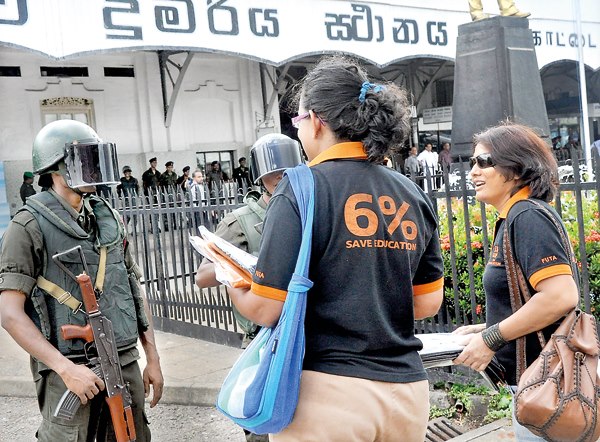
It is important to note that FUTA’s campaign in 2012 was articulated in an effort to highlight these issues in the education sector and to draw attention to the very real problems in education as a result of inconsistent and ad-hoc policy changes and initiatives. It also wanted to generate a broader debate on the crisis of education so that interventions to resolve the ‘crisis’ were not simply in terms of increasing employability or making education more market oriented but taking into account broader development goals. Therefore, any increase in the allocation for education, needs to be assessed in the broader context of the government’s policy on education: whether the government has shown any signs of actually understanding the crisis in education in a more holistic way.
In the first instance, however, there are serious doubts as to what the exact allocation for education is and how much it has increased. For the first time, the 2016 budget includes an item called the ‘Capital Carrying Cost of Government’ in the education section. This new item amounts to Rs. 121,000 billion out of Rs 167,613 billion allocated as ‘ Recurrent Expenditure’ (Note prepared by the Collective for Economic Democratisation, on 25th Nov 2015). It is not clear what this budget item actually means. Also, although the budget includes increased allocations for things like teacher training, teacher deployment, improving science education, it is not clear how this money is actually going to be used. In the section on higher education, a considerable amount has been allocated for the establishment of an extremely oddly named ‘Mahapola University’. What this university is about, no one seems to really know except that it is to honour the founder of the Mahapola Scholarship Scheme, the late Lalith Athuladmudali. So, although there are indications that the allocations for education have increased compared to previous years, how this increased allocation is going to be spent is unclear. According to the budget analysis carried out by the Collective for Economic Democratisation, with the inclusion of the mysterious capital carrying costs, the allocation is around 3.7% of GDP. Once the capital carrying cost is removed, the allocation is 2.72% of GDP. Even 2.72% is an increase from previous years – however, what is of concern is that the government is attempting to show this increase as more (a clear attempt to mislead the public.) This is an extremely worrying indication of how this government deals with the public: mainly through lies and manipulation of figures. This was precisely the kind of political culture that Sri Lankan citizens hoped to change this year. What the Finance Minister said in relation to education also requires attention since it represents the government’s policy priorities.
In his budget speech, the Finance Minister says that there are questions about the “relevance of local universities to private sector employability” and highlights allocations to provide incentives for courses that are directly linked to employment; endowments for research that adds value to the economy; to support the establishment of the Mahapola University to offer market oriented courses; and crucially agrees with the previous government’s decision to allow private universities to function and states its intention to continue this policy–except in offering medical degrees. This clearly shows that the new government intends to continue with the policy of ‘commodifying’ education – in other words, to define the purpose of education in extremely narrow ways.
What is ironic here (from a government that is openly supportive of the market economy) is that this completely misses the important point that the kind of innovation, creativity and drive that is required for a flourishing market led economy, cannot be generated through such an instrumental view of education. So even from the point of view of the kind of education that is required from a liberal economic point of view, the sentiments of this government on education as indicated by the Finance Minister are unimaginative and outdated. From the point of view of equity and social justice, it is clear that the assault on quality public education will continue under the new government. This assault comes primarily through continuing the policy of redefining education in narrow, instrumental terms where educational institutions are primarily expected to cater to the demands of employers. In an economic environment which is facing many challenges, this will essentially lead to the ‘dumbing down’ of education. If you take this thinking to its logical conclusion, Sri Lanka’s economy doesn’t require universities, but simply vocational colleges. It doesn’t require schools – simply tuition classes that prepare students to pass examinations.
So the crisis in education continues – and the crisis is not simply one of inadequate funding or resources – but more seriously – one of a severe lack of ideas, vision and imagination from decision makers and policymakers on the meaning and value of education.

