

By Hiyanthi Peiris –

Hiyanthi Peiris
“A girl is first under the protection of her father, then under the protection of her husband, then under the protection of her son and then she dies.”
At first sight, this seems like a very innocent concept. It encourages familial love, protection of women and is overall the right sentiment to propagate. However, notice that the woman is never given her own agency- instead she is always discussed in a position of relational identity to a male.
In 2012, the Delhi Gang rape got everyone talking. Jyoti, who would later come to be known as Nirbhaya (fearless), was gang raped at around 10pm in the night in public transportation in New Delhi. Her case, despite the existence of many other cases of gang rape was used as the rallying point for India to make a stance against rape. This is because Jyoti’s story is quite difficult to construe as one in which she was “asking for it” although many people did try to construe it that way too[1]. Jyoti was what Indian and South Asian culture loves to call a “good” girl- she was a hard working medical student, who was working on little sleep to excel in her exams, was out and about accompanied by a male presence and not by herself, with an inspirational story about overcoming poverty and struggles, whose only crime against culture was that she was out “late” at night. This is why India was quick to react and make her the face of the struggle against sexual abuse of women. However, what about the girls who were raped or sexually assaulted while they were committing the so-called heinous offenses of traveling alone and dressed “indecently.”
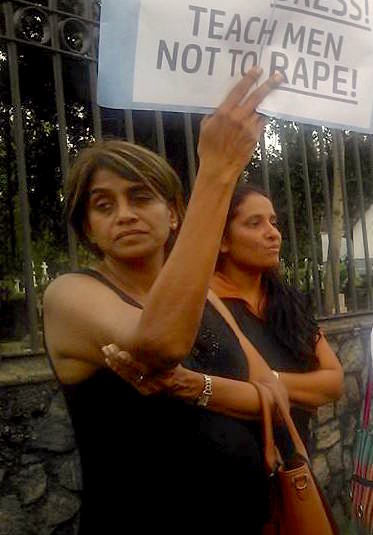 Similar to what happened in India, a 17 year old student, Vidhya, from Jaffna was raped and killed by 9 individuals. She was a student in school uniform, and was abducted and raped on her way to school. Although her case was initially not given enough attention to, the protests in the North ensured that justice was served. However, there were some seriously shameful posts and articles being made about how the North was simply causing a scene about nothing. The fact of the matter is that the North is still struggling to get back on their feet after the war- they are struggling to hold on to their identity, language, culture and reclaim what was once theirs, while the government struggles to help them and every other victim of the war. The least we can do is to be sympathetic to their needs, rather than dismiss them.
The common mentality that poses the real challenge to overcoming the problem of sexual abuse is that it is the victim’s fault. Read this article by Mr. Muhammed Fazlthat discusses exactly how women are to be blamed for rape[2]. My initial emotions of anger and disgust towards the author of this article were soon overtaken by sadness. Honestly, the sentiments in this article are hardly surprising. Having been born and raised in Sri Lanka, I know how our sex education was restricted to one chapter of a book on puberty and how this was a time to expect changes in your body. Most of our sex ed revolved around why having sex was bad, because it led to numerous diseases like HIV/AIDS, gonorrhea, etc. I had to wait till I came to college to start having conversations about consent and intimacy and the importance of affirmative consent. These concepts are completely foreign to the average Sri Lankan who resorts instead to pornography to learn about sex. Are we really surprised that in this kind of environment, the attitude that women are to be blamed for rape still finds a voice? Are we surprised that in the presence of this voice, the only key cases that united India and Sri Lanka to take a stance against rape, were cases that involved two stereotypically good girls? I mean, we are talking about a country that has still to acknowledge and treat marital rape as a crime[3]. We are talking about a country where 97% of perpetrators of sexual violence go unpunished for their crimes[4]. What about the cases of girls who were victims of rape, but were not in accordance with the strict antiquated cultural laws that govern our understanding of rape and sexual violence? What about the rape victims that India and Sri Lanka are hesitant to call their daughters?
Look at this poem by Shamila Daluwatte, Attorney-at-Law, that went viral after Vidhya was killed at the hands of her rapists.
“First they raped ManamperiAnd buried her body aliveI did not speakBecause there was an insurrectionThen they came for women in KahawatteI did not speakBecause I was not from KahawatteThen they came for women in NuriwatteI did not speakBecause I did not live in NuriwattaThen, they came for Women in the NorthI did not speak, becauseKrishanthi Kumaraswami, koneshwari, IsaipriyaThey were not my sistersThen they came for women with a different skin colourEight men gang-raped Victoria AlexandraI did not speakBecause she was just a foreignerThen they gruesomely gang-raped Rita JohnStabbed her body fifteen timesLeft her murdered body on the Modera beachI did not speakBecause she was an IndianShe was asking for troubleBy walking on the beachwith her jewelries in the eveningThen they gang raped a woman in WijeramaI did not speakBecause she was just a prostituteThen they raped hundreds of virginsAnd celebrated with champagnein Akurassa and MonaragalaI did not speakBecause too scared of politiciansThen they raped LogaraniThrew her naked body into a sacred templeThen they gang raped Saranya SelvarasaI did not speakFinally they rapedVithiya SivaloganadanI did not speakBecause she is TamilShe lived on a small Island in Punguduthevu”
This poem brings to light the hypocrisy of Sri Lanka, and how we choose when to stand up and speak up. It shows how we have as a society almost made it okay to not speak up against the rape case of a prostitute, “because she was just a prostitute.” It shows how we have as a society almost made it okay to stay silent over the rape of Rita John, because “She was asking for trouble…. By walking on the beach… with her jewelries in the evening.”
No. This is the mentality that needs to change.
The point of the matter is that regardless of whether the victim was wearing jewellery, a short skirt, or an abaya… regardless of whether the victim was a virgin, a prostitute, someone who had sex before marriage, or not at all, a victim is not to be blamed for rape, which is an illegal and heinous crime. Blaming it on the victim almost seems like making male entitlement acceptable and assuming that males are unable to control their sexual urges, leaving women to the obvious choice of hoping that their actions don’t tempt them. It teaches women to view their bodies as something to be ashamed of and something that is simply sexual.
Vidhya’s case in Sri Lanka and Jyoti’s case in India, started many difficult and very necessary conversations about rape. But they are still conversations that are restricted by cultures that treat women as subordinates of males, in relation to males, or by calling them flowers or goddesses who are so pure that they should be responsible for their actions- a clever way of masking victim blaming. Instead, what we need is to rethink our sex education. Rethink the psychology that we promote, because according to this study[5], 66% of Sri Lankan men who perpetrated rape against women admitted that their motivation for rape was sexual entitlement, and only 34.2% of these respondents felt any remorse for their actions. While Vidhya and Jyoti’s cases provided a much need start to these conversations, we need to ensure that these conversations and reforms are not restricted and inhibited by the outdated and victim blaming culture promoted by articles such as Mr. Fazl’s article on “Are Women to be Blamed for Rape?” The answer, is no.
(Mr. Fazl goes on to justify his article in his comments section, by citing Saudi Arabia as a great example of a place where putting women in their place led to lower rape statistics, and by claiming that he was not blaming all women for rape- just the victims).
We need to work together to educate and understand. And to do that work, we need to start by acknowledging the existence of the problem. To deny the problem by pointing at other countries that have larger problems is to run away from the issue of women’s rights in Sri Lanka. For example, this happened in India[6].
Rest in peace, Vidhya and Jyoti. Justice has been served, more or less. But there is a lot more work to be done in the name of those victims that India and Sri Lanka are not ready to call their daughters. Being named India’s or Sri Lanka’s daughter is not the only reason that people should stand up for your rights, because women, including Jyoti and Vidhya, have identities and roles that are not limited and restricted to their relational position in society as mothers, wives and daughters. Women are also students, employees, employers, workers and caregivers.
All victims of rape deserve justice and deserve the right to not be blamed and shamed.

